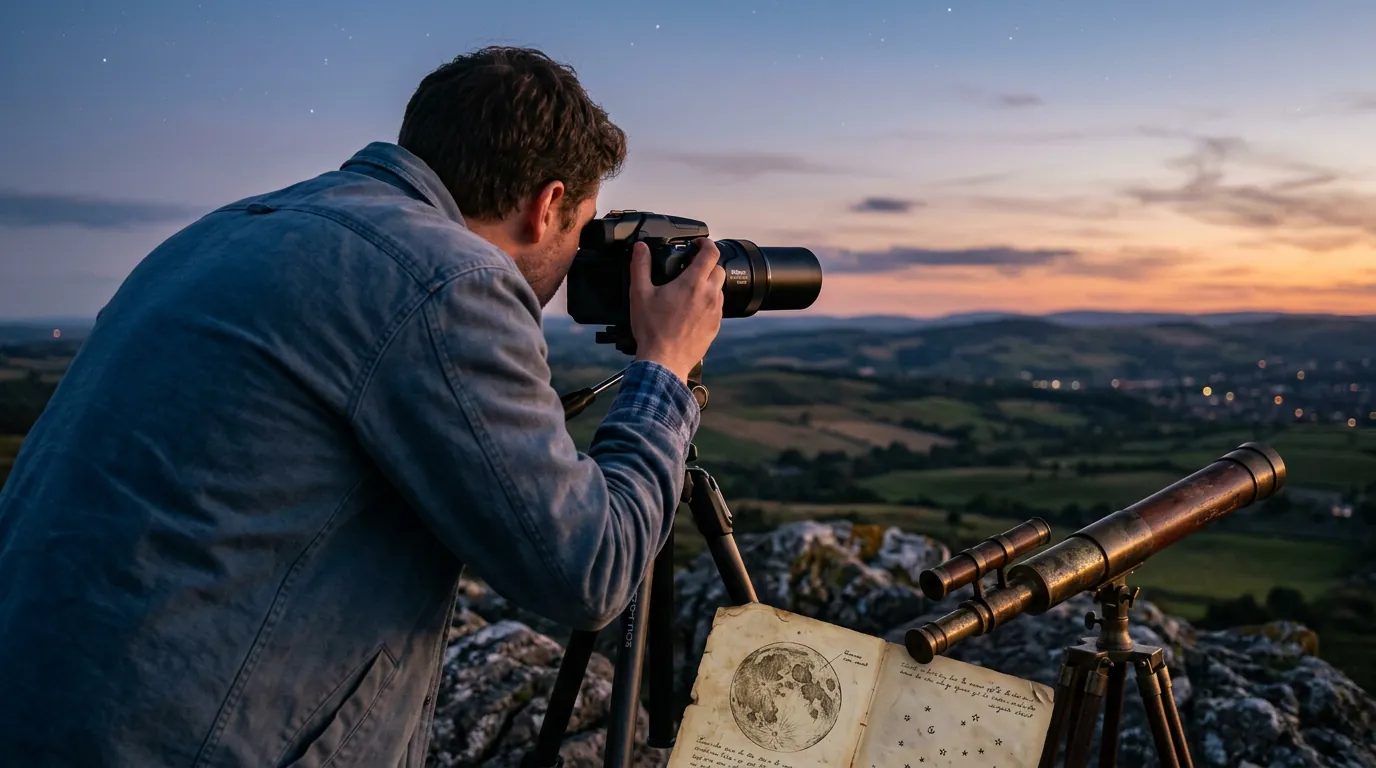
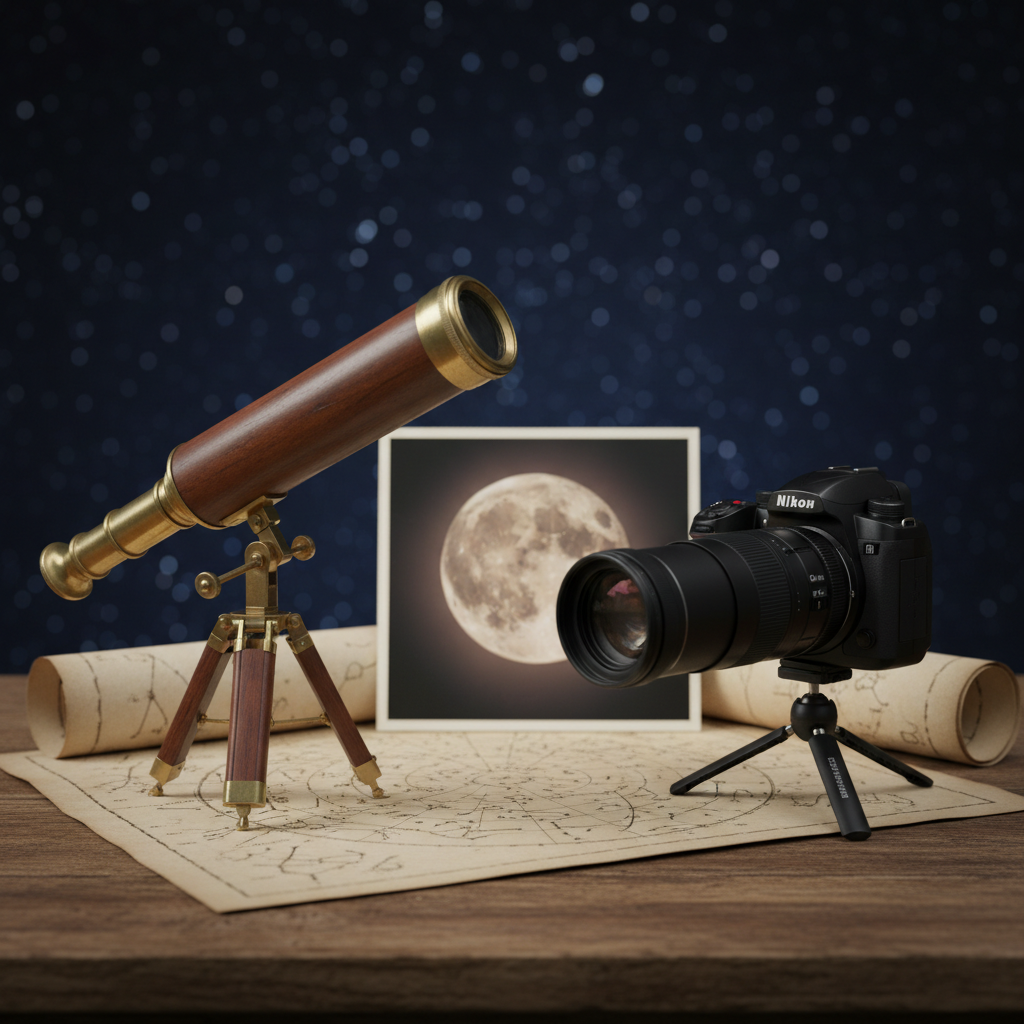
Introduction: Bridging Four Centuries of Stargazing
In 1609, Galileo Galilei didn’t just point a tube of glass at the sky — he pointed a method. With a handmade refracting telescope he refined from Dutch designs, he saw (and then dared to publish) things that made the “perfect heavens” look messy and physical: mountains on the Moon, the phases of Venus, and four small moons orbiting Jupiter.
Four centuries later, the Nikon Coolpix P1000 (2018) is not an astronomical telescope at all. It’s a bridge camera — a consumer device built for wildlife, sports, and “I want that thing way over there.” But its extreme 24–3000mm (equivalent) zoom, stabilization, and instant digital capture let ordinary people document the Moon and bright planets in a way that would have felt like sorcery in 1610.
So what happens if we treat them as two answers to the same human impulse — bring the sky closer — and compare them honestly?
Galileo’s Telescope: A Breakthrough Built on Constraints
Galileo didn’t invent the telescope (that credit belongs to Dutch spectacle-makers around 1608), but he aggressively iterated until it became a serious astronomical instrument.
A representative “best” Galilean scope around early 1610 looked roughly like this:
- Type: refractor (convex objective + concave eyepiece)
- Objective diameter: ~37 mm (varies by surviving reconstructions)
- Magnification: ~20×
- Focal length: ~1 meter (order of magnitude)
What made it hard
- Optical quality: early lenses had bubbles, zones, and significant chromatic aberration.
- Tiny usable field: the apparent field was narrow; tracking objects was like looking through a keyhole.
- No photography: every observation had to be drawn, described, and argued for.
What made it historic
Because the claims were checkable. Anyone with a similar instrument could verify:
- the Moon has relief (shadows and terminator detail)
- Jupiter has moons (and they move night to night)
- Venus shows phases (which supports heliocentric geometry)
The telescope didn’t “win” by being perfect — it won by making nature speak louder than authority.
The Nikon Coolpix P1000: Not a Telescope, Still a Moon Machine
The P1000 is a camera with a small sensor and a comically long zoom. That sounds like a toy until you realize what it gives you for bright targets:
- Sensor: 16 MP, 1/2.3" type
- Lens (equiv.): 24–3000mm (125× optical zoom)
- Max aperture: f/2.8 (wide) to f/8 (full tele)
- Stabilization: optical VR + modern metering/exposure
At full tele, the actual focal length is about 539 mm. With f/8 at the long end, the entrance pupil is ~67 mm — meaning it can gather meaningfully more light than Galileo’s ~37 mm objective.
The modern tradeoffs
- The sensor is small, so high-ISO noise shows up quickly on dim objects.
- For planets, your limit is often atmospheric seeing, not lens sharpness.
- It’s amazing for the Moon and bright planets — but it’s not built for deep-sky astrophotography.
Still: the fact that you can shoot, review, stabilize, and share a lunar close-up in minutes is a real kind of democratization.
Head-to-Head: What’s Actually Comparable?
A telescope is an eyepiece experience (magnification). A camera is an imaging system (resolution + sampling + processing). So instead of forcing a fake “×” war, compare the things that map to what you can see or record.
Core metrics (order-of-magnitude, not marketing)
| Metric | Galileo (c. 1610) | Nikon P1000 (2018) | Notes |
|---|---|---|---|
| Objective / entrance pupil | ~37 mm | ~67 mm (at full tele) | Light gathering scales with area. |
| Magnification / image scale | ~20× visual | 539 mm actual focal length (3000mm equiv.) | Different categories; camera uses sensor sampling. |
| Diffraction limit (theoretical) | ~3–4 arcsec | ~1.7 arcsec (67 mm @ 550 nm) | Real-world is worse due to optics + seeing. |
| Usable field & ergonomics | narrow, manual | wide-to-narrow, stabilized, LCD/EVF | P1000 wins massively on usability. |
| Recording | hand sketches | 16 MP files, video, bursts | Digital permanence changes everything. |
What each can do well
Galileo (and a good modern replica):
- teaches you how discoveries happen
- shows the “big” revelations (Venus phases, Jupiter’s moons)
- makes the sky feel physical with minimal tech
P1000:
- makes the Moon easy and repeatable
- makes “proof” trivial (photos/videos)
- lets you learn by iteration (settings, focus, exposure) instead of rhetoric
The Human Factor: Then and Now
Galileo’s real superpower wasn’t the tube — it was persistence plus publication. He observed repeatedly, drew carefully, and wrote in a way that forced a conversation.
The P1000’s superpower is different: it collapses the distance between curiosity and evidence. You don’t need patronage, a workshop, or a printing press. You need a clear night and a battery.
And yet, both are limited by the same final boss: the air above your head.
At extreme focal lengths, turbulence blurs details no matter how modern your gear is. In a poetic way, the atmosphere keeps the sky slightly out of reach — so we keep trying.
Conclusion: Pixels Beat Polish, but the Spark Is the Same
If the goal is: “Show me the Moon up close tonight”, the Nikon Coolpix P1000 wins without mercy. It’s brighter at the long end, wildly more usable, and it records what it sees.
If the goal is: “Remind me what it felt like when the universe changed”, Galileo’s telescope still has no replacement. It’s the moment when careful observation stopped being decoration and became an argument.
Next clear night, point whatever you have at the Moon — a P1000, binoculars, or a cheap refractor — and you’ll be participating in the same tradition: evidence first, wonder always.
Sources / references
- Galileo Galilei, Sidereus Nuncius (1610)
- Museo Galileo (Florence) — historical context and instrument reconstructions
- Nikon technical specifications for the Coolpix P1000 (lens range, aperture, sensor)